

Waiting, Actually
(It’s time to talk about what’s missing in your nativity scene)

Somewhere on a perfect garland-draped sideboard sits a porcelain nativity display aglow with golden Christmas lights. Mary gazes lovingly down at little baby Jesus, often not swaddled at all but rather naked and freefalling into the bale of hay below. Joseph joins her, a lantern in hand. Wise men hold exotic golden treasures and look a little bit like extras from Pirates of the Caribbean. Bearded shepherds gaze in wonder with sheep at their sides. An Angel clasps her hands in prayer, wings spread wide over the humble group.
The gang’s all here.
…or are they?
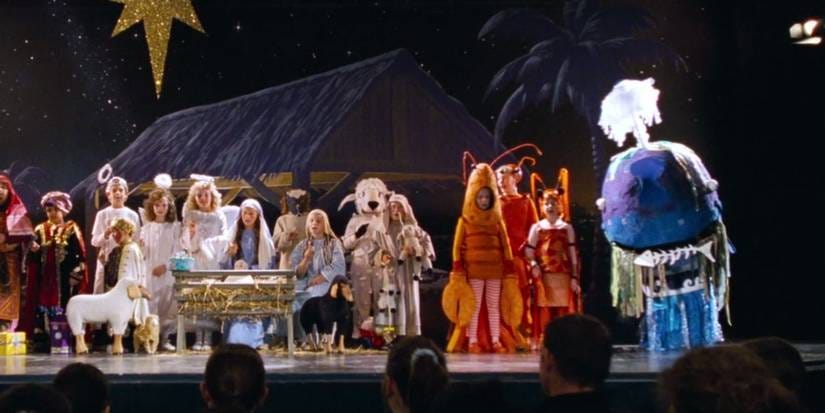
It wasn’t until a year after my husband died that I discovered a pretty major hole in the figurines I grew up admiring (but never touching! I promise, Mom. Even though they were very close in size to Barbies and thus, extremely tempting). And no offense to shepherds, but this missing piece might just be the most crucial to the narrative.
It’s time to talk about the widow you’ve all been leaving out of your Christmas story!
I’m confident you never donned a black veil in your church Christmas program as a child or placed an old lady holding a tiny box of tissues next to the wise men. And as a storyteller, I find this appalling! Because at the end of the day what is advent all about?
Peace?
Hope?
Joy?
Love?
Yes of course, but above all, waiting for all of these warm fuzzies to arrive. “Born that man no more may die!” we sing triumphantly from our pews while at the same time, leaving out the character most familiar with death! Jesus is the hope of the world ultimately because he promises the end of suffering. And no one knows suffering better than…
…our girl Anna.

She shows up in the story when Jesus is brought to the temple at forty days old. So yes, you could argue that an Anna figurine positioned next to the livestock would hardly be an accurate representation of real events. But your arguments are moot if you’re still letting the wise men in on the sideboard party! Matthew describes Jesus as a “young child” by the time these dudes rolled in. At least Anna was bringing her griefy energy to a still baby-ing baby Jesus!
The Bible says that Anna was widowed after only seven years of marriage. Luke tells her story like this:
“She was very old; she had lived with her husband seven years after her marriage, and then was a widow until she was eighty-four. She never left the temple but worshiped night and day, fasting and praying. Coming up to them at that very moment, she gave thanks to God and spoke about the child to all who were looking forward to the redemption of Jerusalem.” Luke 2:36-38 (NIV)
We know little of Anna except for this short story, but we know that waiting seemed to be a huge part of her existence. Like her, I know how it feels to lose a husband so quickly into a marriage—to have future plans and children ripped away. I know what it is to need a coming savior. Like Anna, I refuse to accept that death is the end of the story. C.S. Lewis, fellow member of the wid club with Anna and myself, describes this sort of desperate need for the end of death perfectly in A Grief Observed, saying:
“Bridge-players tell me that there must be some money on the game ‘or else people won’t take it seriously’. Apparently it’s like that. Your bid—for God or no God, for a good God or the Cosmic Sadist, for eternal life or nonentity—will not be serious if nothing much is staked on it. And you will never discover how serious it was until the stakes are raised horribly high; until you find that you are playing not for counters or for sixpences but for every penny you have in the world. Nothing less will shake a man--or at any rate a man like me--out of his merely verbal thinking and his merely notional beliefs.”1
Anna was indeed “playing for every penny” she had in the world after losing her spouse. She uprooted her whole life to wait at the temple, and her inclusion in Luke’s account of Jesus’ arrival is no coincidence.
When something catastrophic occurs in your life, you start to see it everywhere, even in Bible stories you used to blaze right through. Today, as I enter this season of waiting and anticipating the hope of Christmas, I notice my fellow desperate waiters. Like Hugh Grant smoothly narrating loved ones arriving at the Heathrow Airport, I watch the hurting standing in line at stores and gracing the walls at crowded parties looking for an excuse to go home. I see my single mom friends making Christmas magic for their kids on social media and my fellow grievers pasting on a smile when they’d rather curl up in bed until January. Hugh says “it’s always there— fathers and sons, mothers and daughters, husbands and wives… if you look for it, I’ve got a sneaky feeling…”
Waiting actually is… all around.
And so fellow waiters and grievers and those who desperately need a savior to rescue them from all the terrible, consider this my official petition to include Anna in your next children’s program or nativity display. After all, why should we let Hallmark hog all the good widow stories?
Lewis, C. S. A Grief Observed. HarperOne, 1961.
❤️